
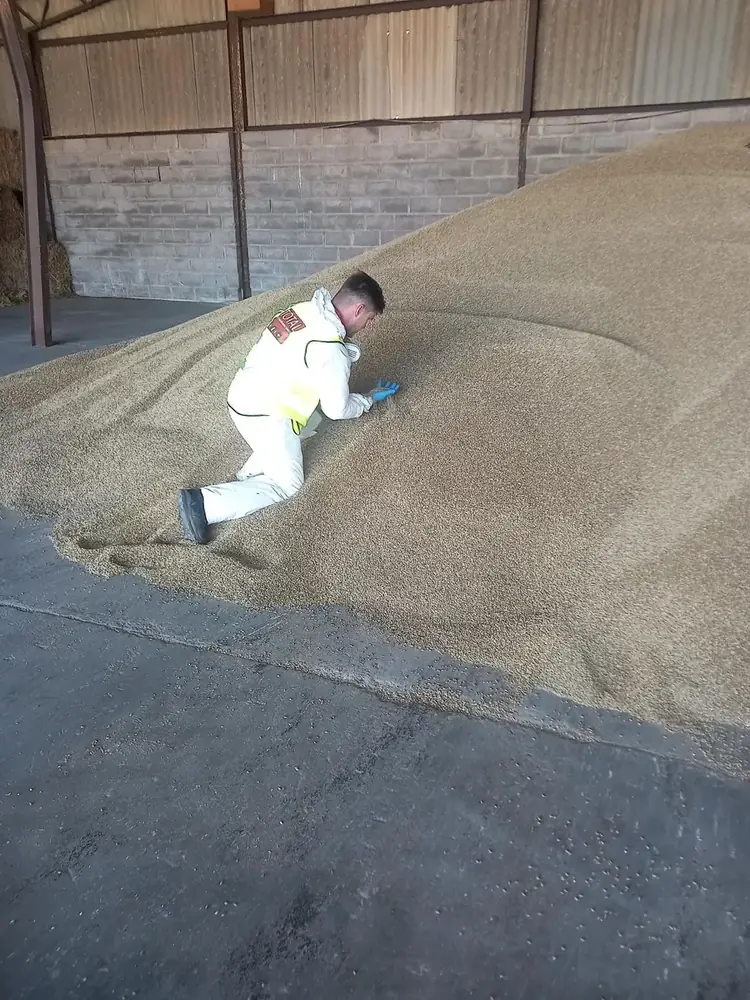
Finding insects in stored grain is a horrible moment. A store that looked clean at harvest can be alive with beetles by spring, and most buyers will reject a load if they find a single live insect at intake. The good news is that grain store fumigation clears an established infestation properly, in one treatment, without moving the grain.
Grain Fumigation Services is a family-run business with over 40 years of experience fumigating grain for farmers, traders, millers, shippers, importers and exporters across the UK. We’ll tell you straight whether you need to fumigate, what it involves and what it will cost.
What is grain fumigation?
Grain fumigation is a treatment that uses a gas to kill pests throughout a bulk of stored grain. In the UK, grain store fumigation uses phosphine gas. The active ingredient, aluminium phosphide, releases it once we place it in the store.
Using a gas is what makes the difference. Most grain insects spend their early life inside individual kernels, where sprays and dusts can’t reach them. Phosphine works its way through the whole bulk, so it kills eggs, larvae, pupae and adults, not just the beetles you can see on the surface. That’s why fumigation is the standard answer once insects have taken hold in the grain.
Signs your grain needs fumigating
Insects are easy to miss early on. Check your traps and the grain surface regularly, and give us a call if you notice any of these:
- Live or dead insects in traps, on the grain surface, or around the walls and floor
- Hot spots in the bulk, or temperatures creeping up for no obvious reason
- A sweet, musty smell, which often points to mites
- Webbing or clumped grain near the surface
- Kernels with small, round exit holes, a classic sign of grain weevils
- A load rejected at intake, or a failed inspection by your merchant
The longer you leave an infestation, the more grain it affects. Insect activity also raises temperature and moisture in the bulk, which can lead to mould and sprouting on top of the insect damage.
How our grain fumigation process works
- Survey and quote. We look at the store, identify the pest and check the tonnage and grain temperature. Those three things decide the dose and how long the treatment needs to run, so your quote is accurate from the start.
- Sheeting and sealing. Gas-proof plastic sheets go over the grain, or we seal the silo, bin or container. A good seal keeps the gas at the right concentration, and that is what makes the treatment work.
- Application. Our RSPH-qualified team applies the aluminium phosphide. Warning signs go up and we control access to the area for the whole treatment.
- Treatment period. The fumigant releases its gas gradually, and the gas then works through the grain over 14 to 28 days.
- Gas checks and removal. We check all gas readings before we open anything up, then remove the gas, sheeting and safety signs for disposal.
- Clearance certificate. You receive a certificate confirming the site is safe, ready for your records, your buyer or your auditor.
The process in pictures
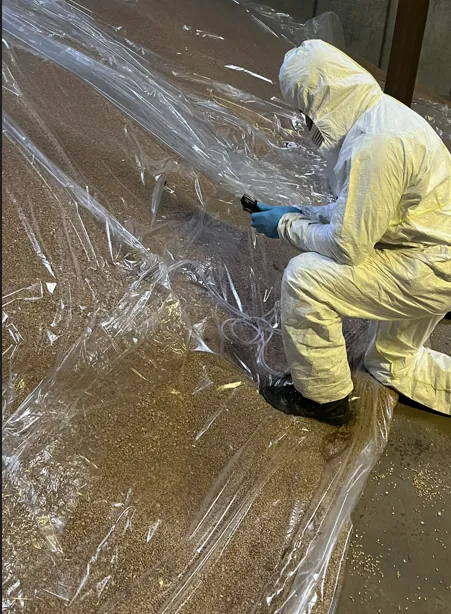
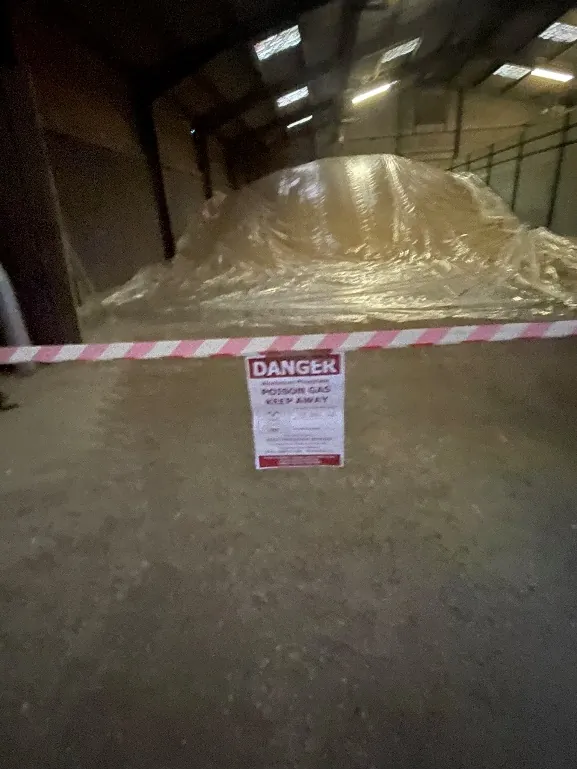
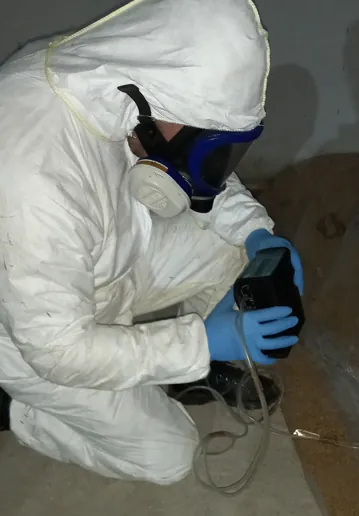
See a full job from start to finish in our case study: rust-red grain beetle in 250 tonnes of barley near Bristol.
How long does grain fumigation take?
The treatment time is usually between 14 and 28 days from sheeting to clearance. The two things that decide it are tonnage and grain temperature. Insects are less active in cold grain, so a cold store needs a longer treatment to make sure it kills every life stage. We’ll give you the expected timetable with your quote, so you can plan around collection dates.
Which pests does fumigation kill?
Fumigation kills all life stages of the stored product pests found in UK grain, including:
- Grain weevils (Sitophilus granarius), whose larvae develop hidden inside whole kernels
- Saw-toothed and rust-red grain beetles, which breed quickly and drive heating in the bulk
- Flour beetles, which feed on broken grain and dust
- Grain and flour mites, which taint grain with a sweet, musty smell
- Stored product moths, such as the warehouse moth and Indian meal moth, whose larvae leave webbing on the surface
Not sure what you’ve found? See our stored grain pests identification guide, or describe it when you call and we’ll help you identify it.
What we fumigate
Phosphine is versatile, so grain store fumigation works wherever you keep your grain:
- Floor-stored grain in sheds and barns
- Silos and bins
- Shipping containers, for importers and exporters
- Grain and commodities held by traders, millers and shippers
Our grain fumigation service covers the whole of the UK, so we can work on the farm, at the mill or at the port.
Is fumigated grain safe?

Yes. Phosphine is a gas, so unlike a spray it doesn’t leave a coating on the grain. When the treatment finishes, we remove the sheets, air the store and let the gas disperse, leaving the grain clean for storage, sale or processing into food and feed. The grain is safe to move a few days after the treatment ends.
Before we sign anything off, we clear the gas, check the readings across the store and remove the sheeting and signs. You then get a clearance certificate confirming we completed the treatment and the site is safe. That certificate is what buyers, mills and assurance auditors ask for, so keep it with your store records.
It’s also why phosphine is the standard fumigant for stored grain, in the UK and worldwide: it reaches insects throughout the bulk, then leaves once the job finishes.
The part that needs real care is the treatment itself. Aluminium phosphide is highly toxic, which is why only trained, certified fumigators should ever handle it, and why nobody should enter a store under treatment until we clear it.
Why farmers choose Grain Fumigation Services
- Over 40 years of experience. We’ve been fumigating grain for a long time, and we’re still family run.
- Properly qualified. Our staff hold RSPH qualifications in the safe use of aluminium phosphide and take part in industry-leading CPD schemes. We also hold PA1, PA6 and PA9 certificates, are NRoSO registered and are SafeContractor approved.
- BPCA members, fully insured. We are members of the British Pest Control Association and hold all relevant insurance to cover our work.
- Fully guaranteed. Every grain fumigation comes with a full guarantee to eradicate all life stages of stored product pests.
- Fast turnaround. We move quickly from the first call, because insects won’t wait.
- Nationwide and competitively priced. One experienced team for the whole of the UK.
How much does grain fumigation cost?
We price every job individually, because no two stores are the same. The main things that affect the price are:
- How much grain needs treating
- The type of store, and how easily we can sheet or seal it
- How long the treatment needs to run, which depends on grain temperature
- Where the store is
Our prices are competitive across the sector, and quotes are free with no obligation. Set against the cost of a rejected load, or a buyer downgrading your grain, fumigation is usually money well spent.
Keeping insects out after fumigation
Fumigation clears the insects that are in the grain. It doesn’t stop new ones arriving, so the best long-term protection is good pest management: store hygiene, monitoring and early action:
- Clean the empty store before harvest. Insects shelter in dust and old residues in cracks and corners.
- Treat the store fabric before the new crop goes in. Our pre-harvest insect treatment uses K-Obiol, Aquapy or organic-approved insecticides, and comes with a certificate for your farm audit.
- Cool grain quickly after harvest and keep it cool. Insects breed far more slowly in cold grain.
- Monitor through the season with insect traps and temperature probes, so you catch any problem early. The AHDB Grain Storage Guide covers store hygiene and monitoring in detail.
Grain fumigation FAQs
Can I fumigate grain myself?
No. Aluminium phosphide is highly toxic, and only trained, certified professionals may use it. Using it without the right training and equipment puts people at serious risk, and the Health and Safety Executive regulates its use.
Do I need to move the grain to fumigate it?
No. We treat the grain where it sits, under gas-proof sheets or in a sealed silo, bin or container.
Can I sell the grain after fumigation?
Yes, once we’ve finished, removed the gas and cleared the site. Your clearance certificate confirms we completed the treatment and the site is safe.
Is grain fumigation guaranteed?
Yes. Our grain fumigation service comes with a full guarantee to eradicate all life stages of stored product pests.
What is the difference between fumigation and a pre-harvest spray?
Fumigation treats grain that is already infested, killing insects throughout the bulk. A pre-harvest spray treats the empty building before harvest, to stop insects living in the fabric from getting into the new crop. Many farms use both.
What do you need from me for a quote?
The type of grain, roughly how many tonnes, how you store it (floor, silo, bin or container), where the store is and what you have found. A quick phone call usually gets things started.
Do you cover my area?
Yes. We fumigate grain across the whole of the UK.
Book your grain fumigation
If you suspect insects in your grain, don’t wait for the next intake check. Call us on 07860 384560 or 01235 819922, or send us a few details and we’ll call you back the same day with advice and a free, no-obligation quote.
Last reviewed